

Metal-Clad Switchgear Continuous Condition Temperature Monitoring: Technology Overview and Selection Criteria

Dec
Continuous Temperature Monitoring – From Optional to Essential
Continuous temperature monitoring in switchgear is no longer optional—it is an operational necessity. Overheating caused by overloaded circuits, unbalanced loads, or loose or damaged connections can significantly shorten equipment life and lead to catastrophic failures.
Temperature rises in medium-voltage switchgear and switchboard components can occur suddenly, often resulting in thermal runaway that causes burning, melting, and destruction of critical components.
Traditional periodic visual inspections are costly, time-consuming, and require strict safety compliance under NFPA 70B & 70E. More importantly, they are unlikely to detect these conditions in time. Best practices now demand 24/7/365 thermal monitoring of switchgear assets, which can identify up to 70% more failures compared to periodic inspections, protecting valuable equipment and improving personnel safety.
The Financial Impact of Power Outages
Power outages are not just operational risks—they represent significant financial hazards. Research indicates that USD 1.35 billion in revenue is lost for every hour of power outage across the top ten U.S. states collectively.
Key findings from industry studies include:
- Weather-related natural disasters account for half of all outage events and over two-thirds of total revenue loss.
- The commercial sector suffers the greatest impact, with predictive models achieving over 80% accuracy in estimating losses.
- Revenue loss is influenced by multiple factors, including electricity sales, customer sector distribution, geography, and economic indicators.
Energy Losses from Loose Connections
Loose electrical connections are a hidden but costly problem:
- EPRI reports energy losses of up to 20% in motors and equipment due to poor connections.
- DOE estimates that correcting poor connections could save $25 billion annually in maintenance and inspection costs.
- LBNL found that improving connections in commercial buildings alone could save $4 billion annually.
The challenge lies in detection: faults caused by loose connections are often intermittent, making them difficult to identify through:
- Visual inspections
- Thermography (infrared)
- Ultrasound inspections
These methods frequently miss early-stage (incipient) faults, allowing energy losses and safety risks to escalate. The solution is continuous 24/7 monitoring, ensuring even intermittent faults are detected promptly, reducing downtime and preventing catastrophic failures.
What Metal-Clad Switchgear Components Should Be Monitored?

Hot spots can develop in busbars, circuit breaker contacts, cables, or any joint or connection point. Critical monitoring points include:
- Line and load sides of Air Circuit Breakers (ACB)
- Busbar joints
- Upper and lower contacts of Vacuum Circuit Breakers (VCB) connected to main and feeder busbar circuits
- Stabs / disconnect switches
- Connections on Current Transformers (CT)
- Incoming cable and feeder joints
- Joints on the main busbar
- Electrical joints on Voltage Transformers (VT)
Selection Criteria for Thermal Monitoring in Medium-Voltage Switchgear
When selecting the best technology for continuous temperature monitoring, consider the following:
- Safety: Sensors must be inherently safe, posing no risk of short circuits, partial discharge, arc flashes, or other electrical hazards.
- Reliability: Sensors should be immune to electromagnetic and radio-frequency interference, with SGS-certified compliance to IEC/EN standards.
- Durability: Sensors must withstand long-term use without deterioration, ideally lasting the equipment’s lifetime (20+ years).
- Accuracy & Integration: Sensors should provide precise readings, be easy to monitor, and integrate seamlessly with existing systems such as BMS or SCADA.
- Ease of Installation: Sensors should be simple to install in both new and retrofit applications, requiring no calibration.
- Cost-Effectiveness: Consider total cost of ownership, life-time warranty, installation, and operational expenses.
Switchgear Temperature Monitoring Choices
Continuous temperature monitoring of switchgear components can be achieved using several technologies. Below is an overview of the most common options, along with their advantages and limitations.
Infrared (IR) Temperature Sensors

Infrared sensors provide contactless temperature measurement and are often considered an upgrade from periodic handheld IR thermography. While inherently safe and immune to electromagnetic interference, IR sensors have significant limitations:
- Line-of-sight requirement: Insulating boots and bus barriers often obstruct direct measurement points.
- Accuracy issues: Measurements are typically ±2°C and can degrade to ±4°C at higher temperatures.
- Limited range: Cannot measure temperatures below 0°C.
- Complex installation: Requires lens brackets, multiple conductive wires, and black targets for emissivity calibration.
- High cost: Installation is tedious and expensive due to alignment requirements and specialized lenses.
Wireless Surface Acoustic Wave (SAW) Sensors

SAW sensors use wireless antennas to read temperature from components mounted directly on the measurement point. While they eliminate line-of-sight issues, they introduce new challenges:
- Interference susceptibility: Wireless signals are prone to electromagnetic noise.
- Installation complexity: Requires loosening bolts and wired connections, which can create arc-flash risks.
- Multiple components: Increased points of failure.
- Bulky design: Often requires custom boots or cut-outs in insulation.
- Limited range: Typically less than 30 cm.
- Accuracy: ±2°C, degrading to ±4°C above 80°C.
- Complex commissioning: Requires frequency allocation and antenna positioning, making installation costly and time-consuming.
Fiber Optic Temperature Sensors
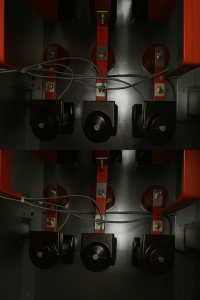
Fiber optic sensors provide direct contact measurement via a ring lug attached to the fiber. Advantages include immunity to electrical noise and high accuracy. However:
- Installation complexity: Requires loosening bolts and wired connections, which can create arc-flash risks.
- Multiple components: Increased points of failure.
- Cost: Higher installation and maintenance costs compared to wireless solutions.
Energy Harvesting (EH) Wireless Temperature Sensors

Energy Harvesting wireless sensors represent the latest innovation in switchgear monitoring. These sensors attach directly to busbars or joints without disturbing torque settings and transmit data wirelessly to a receiver in the LV cabinet. Key benefits include:
- Safety: No risk of short circuits, partial discharge, or arc-flash events.
- Reliability: Immune to electromagnetic and RF interference, certified by SGS to IEC/EN standards. IEC301, IEC220, IEC301, IEC489, IEC62479, IEC 61326-1, IEC62271-1, EN 61284-1997, IEC 60270,IEC 60061-1.
- Durability: Flame-retardant V0 plastic, tested to withstand 700°C for 30 seconds, vibration-tested to DNVGL-CG-0339. Temperature endurance to IEC 60068-2
- Accuracy: Better than ±1°C, with a wide range (-40°C to 125°C).
- Maintenance-free: 20+ years of calibration-free operation.
- Ease of installation: Simple retrofit or factory installation without bolt removal.
- Cost-effectiveness: Lower total cost of ownership compared to Infrared, fiber optic or SAW technologies.
PTSenR™ – EH Temperature Sensing Solutions
PTSenR™ (PTI) offers PTSenR Energy Harvesting Temperature Sensors, designed for industrial-grade applications including switchgear, transformers, generators, and semiconductor equipment. Key features:
- Direct-contact monitoring: Mounted on critical hotspots for real-time data.
- Wireless communication: Sensor to Receiver
- Communication Protocol: HMI standard with dual RS-485 Modbus RTU, Ethernet and dry contact.
- Scalable architecture: Panel-mounted HMI receiver for multi-point monitoring.
- Smart Grid compatibility: Ideal for high-voltage environments where conventional sensors fail.
PTSenR™ Advantages:
- Wide temperature range (-40°C to 125°C).
- Accuracy better than ±1°C.
- Maintenance-free for 20+ years.
- Life-time warranty
- Immune to electromagnetic interference.
- Cost-effective and easy to install.
System Components:
- Temperature Sensor: PTSPS061, PTPS075, PTSPS067
- Temperature & Humidity: PTSPS114
- Display Receiver HMI Module: PTSPW2000F.

Summary
Several technologies exist for continuous switchgear temperature monitoring, including IR sensors, SAW wireless sensors, fiber optic sensors, and EH wireless sensors. Among these, PTSenR™ Energy Harvesting wireless sensors from Power Technologies offer the most reliable, accurate, and cost-effective solution, ensuring long-term safety and operational efficiency. Power Technologies, a leader in advanced monitoring solutions, provides scalable, maintenance-free systems designed to protect critical electrical infrastructure and reduce downtime, delivering both operational resilience and financial savings.
