

Why Dry-Type Maintenance Is Shifting
Sep
Don’t Wait for the Transformer to Fail: Why Dry-Type Maintenance Is Shifting from Temperature Checks to Full-State Perception
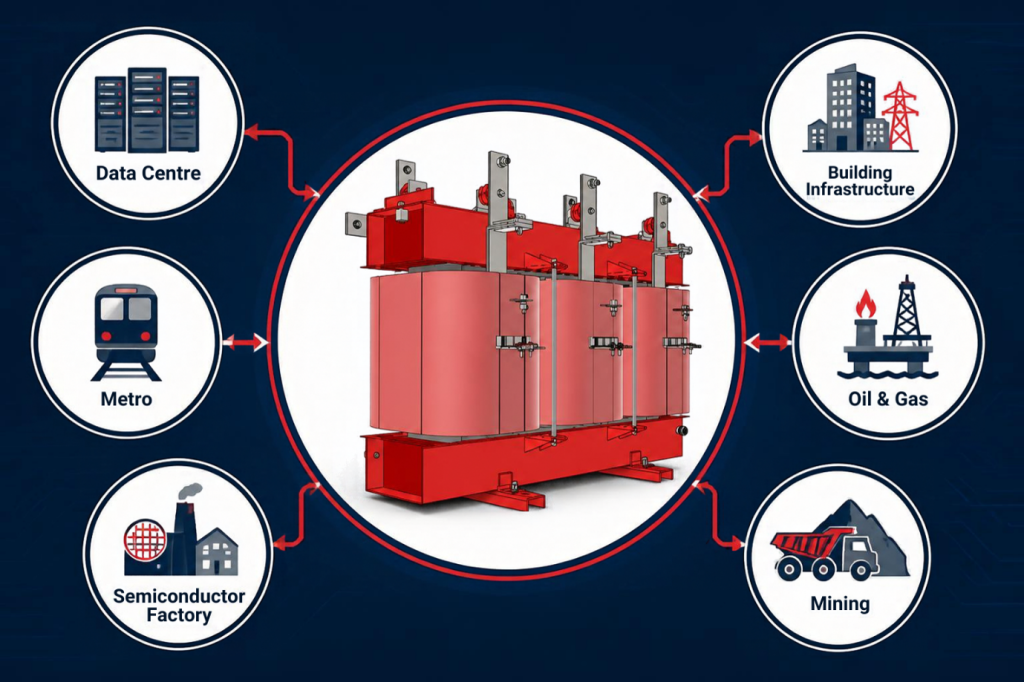
In mission-critical environments—data centers, rail transit hubs, heavy industrial plants, medical campuses, and high-density commercial towers—dry-type transformers operating up to 52 kV serve as the backbone of electrical distribution. When one of these units faults, the consequences rarely stay isolated. An unexpected trip cascades downline, halting processes, idling servers, and incurring massive downtime costs.
Yet, a persistent disconnect remains between the criticality of these assets and how they are maintained: the equipment has grown increasingly vital, but the monitoring philosophy has remained largely static.
- Beyond Temperature: The Blind Spot of Single-Parameter Monitoring
Historically, condition monitoring for dry-type transformers began and ended with a temperature controller. While thermal management is fundamental—overloaded windings and clogged cooling channels inevitably manifest as elevated temperature rise—normal temperatures do not guarantee a healthy asset.
- Loose or degraded busbar connections create localized micro-hotspots before bulk winding sensors ever register an anomaly.
- Insulation breakdown and tracking produce high-frequency partial discharge (PD) signals long before significant thermal runaway occurs.
- Mechanical loosening or core displacement reveals itself through subtle vibration harmonic shifts, completely invisible to thermal probes.
- Power quality degradation and non-linear harmonic loading stress insulation without triggering instant trip thresholds.
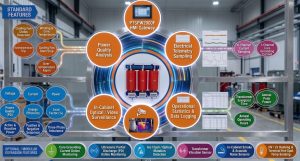
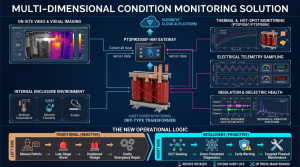
A single metric only provides a partial glimpse. Modern intelligent maintenance demands a shift from isolated temperature tracking to multi-dimensional perception: continuous thermal profiling, electrical dynamics, partial discharge, mechanical vibration, and internal enclosure conditions.
- Three Paradigms Reshaping Transformer Maintenance
Paradigm 1: From Periodic Inspections to 24/7 Continuous Condition Monitoring
Manual route-based inspections capture only a single snapshot in time. A transformer operates normally during an afternoon walk-through, develops an insulation defect three days later, and trips before the next scheduled cycle.
Continuous online monitoring moves facility teams from asking “Is the equipment running right now?” to evaluating “What is the equipment’s current health trajectory, and what trends are emerging?”
Paradigm 2: From Isolated Signals to Multi-Parameter Collaborative Diagnostics
Equipment failure rarely stems from a single isolated cause. Evaluating an asset across multiple operational planes paints a complete diagnostic profile:
| Diagnostic Domain | Monitored Parameters | What It Detects |
| Thermal | Multi-point busbar & winding temps | Localized high-resistance joints, cooling airflow failure |
| Electrical | Current, 3-phase imbalance | Phase imbalance |
| Dielectric | UHF, TEV, AE, and HFCT Partial Discharge | Insulation aging, surface tracking, void discharge |
| Mechanical | Tri-axial core & winding vibration | Loose clamping bolts, core deformation, dynamic mechanical stress |
| Visual / Environmental | Internal enclosure video, ambient temp, RH | Moisture ingress, rodent intrusion, discoloration, surface dusting |
Paradigm 3: From Reactive Remediation to Predictive Health & Asset Longevity
Asset monitoring creates value well before an alert fires. By feeding continuous telemetry—hot-spot temperatures, cumulative PD activity, load rates, and vibration spectrums—into physics-informed models (such as the Arrhenius thermal life degradation model) paired with machine-learning algorithms, engineering teams can forecast remaining useful life (RUL) and schedule condition-based overhauls during planned maintenance windows.
- Engineering Precision at the Sensor Level
A predictive platform is only as dependable as the raw telemetry it captures. Deploying sensors inside medium-voltage enclosures introduces unique insulation, safety, and electromagnetic interference (EMI) constraints.
- Passive, Energy-Harvesting Thermal Sensing: Utilizing battery-free, passive energy harvesting sensors (such as the PTSPS061/086 series) eliminates the maintenance headache of battery replacements inside energized switchgear. Certified to rigorous IEC, EN, UL, KC, and MIS safety standards, these compact units install directly onto high-voltage terminals and tapping connections, measuring -40°C to +125°C hot spots with ±1°C accuracy.
- Multi-Modal Partial Discharge Detection: Combining Ultra-High Frequency (UHF), Transient Earth Voltage (TEV), Acoustic Emission (AE), and High-Frequency Current Transformers (HFCT) enables sensitivity down to 5 pC, identifying discharge signatures while filtering out external switchgear background noise.
- Mechanical Vibration Fingerprinting: Tri-axial accelerometers track core resonance shifts and loose fastening structures under dynamic load cycles.
- In-Cabinet Optical Visualization: Remote infrared and optical imaging sensors inside the enclosure bridge the gap between numbers and physical reality. Telemetry identifies where an anomaly is brewing; real-time video lets maintenance engineers immediately verify physical conditions (e.g., condensation, dust accumulation, or connection discoloration) without racking out equipment or staging an arc-flash-rated visual inspection.
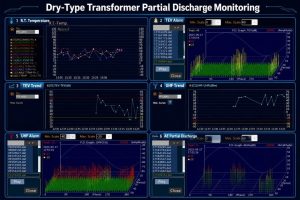
- Scalable Architecture: Modular Deployment for Targeted Risk
Not every dry-type unit in a plant carries identical downtime risks. Implementing an all-in, fully instrumented suite across every auxiliary transformer inflates capital expenses unnecessarily.
A modular monitoring framework (anchored by an integrated host such as the PTSenR architecture) allows operators to tailor deployment to asset criticality:
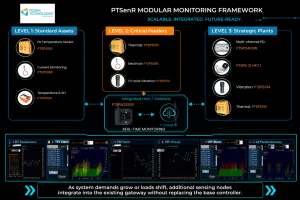
As system demands grow or loads shift, additional sensing nodes integrate into the existing gateway without replacing the base controller.
The New Operational Logic
The evolution of dry-type transformer management represents a fundamental shift in operational workflow:
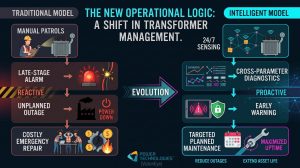
By integrating comprehensive field sensing with edge analytics and platforms like VizionEye AI, operators transform dry-type transformers from operational blind spots into transparent, predictable assets. Maintenance no longer waits for an audible flashover or an emergency trip to take action.
Technical Specification: Click to read
