

From Manual Checks to Data-Driven Maintenance: The Future of DC Bus Temperature Monitoring
Oct
From Manual Checks to Data-Driven Maintenance: The Future of DC Bus Temperature Monitoring
In high-voltage electrical environments, heat is the silent enemy. For critical infrastructure relying on DC buses, unchecked temperature increases are a leading indicator of impending trouble. Whether it’s due to insulation degradation or poor contact at switch joints, excess resistance generates heat that, if left unmonitored, can quickly escalate into catastrophic system failures or even electrical fires.
For years, the industry has relied on time-based manual inspections to catch these issues. But as power demands grow and systems become more complex, is a periodic check really enough?
Here is a look at the challenges facing traditional temperature monitoring and how advanced fiber optic technology is enabling a shift toward true, data-driven maintenance.
The Pitfalls of Traditional Monitoring
Facility managers and maintenance teams face significant hurdles when trying to monitor high-voltage equipment:
- The Inspection Gap: Human time-based inspections—like weekly or monthly thermal imaging sweeps—only provide a snapshot in time. A joint can pass inspection on Tuesday but develop a rapid thermal anomaly by Friday, leaving the system vulnerable between scheduled checks.
- Safety Hazards: Sending personnel to manually measure temperatures on active, high-voltage components inherently introduces severe safety risks.
- Electromagnetic Interference (EMI): Why not just use standard electronic sensors? High-voltage environments are incredibly noisy from an electromagnetic perspective. EMI frequently disrupts conventional electronic temperature sensors, leading to false alarms or dead signals precisely when you need them most.
The Fiber Optic Solution: PTSenRM PTSGL Series
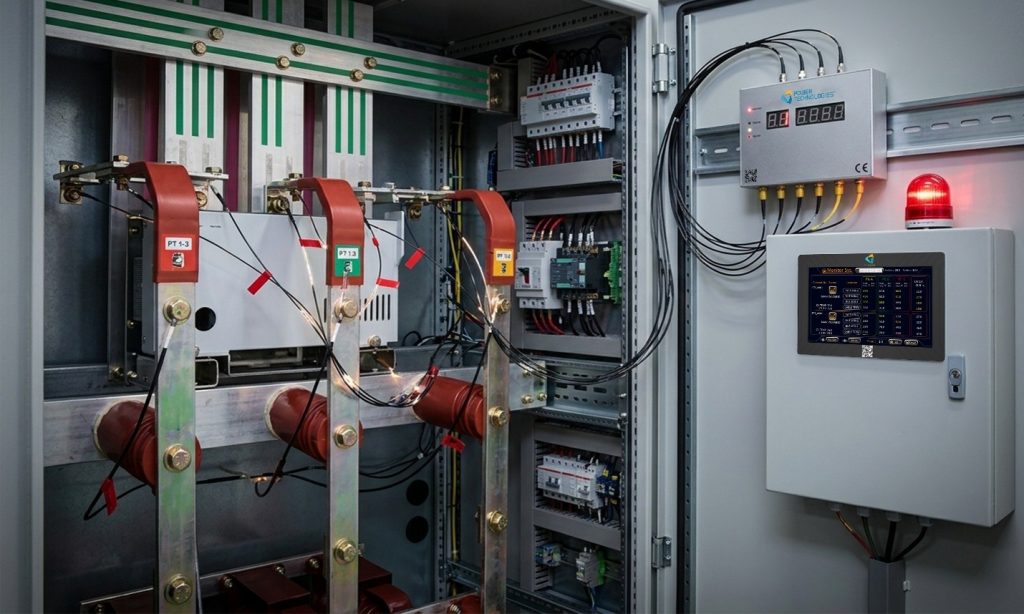
To overcome these challenges, the industry is turning to fluorescent fiber optic technology, such as the PTSenRM PTSGL (3/6/9/12 channel) series.
Designed specifically for high-voltage environments, the PTSGL series fundamentally changes how we approach thermal management by replacing sporadic human inspections with continuous, automated oversight.
How It Works (and Why It Matters)
Instead of relying on electronic signals, these advanced devices use light. They measure temperature by detecting the decay rate of fluorescence after a material is excited by a light pulse. Because the signal is 100% optical, the sensors are completely immune to electromagnetic interference.
Here is how this technology is driving data-driven maintenance:
- Direct-Contact Accuracy: Unlike infrared cameras that measure surface temperatures from a distance, PTSGL sensors feature a contact-based installation. They are mounted directly onto high-voltage components like cable joints and switch contacts, providing highly accurate (±0.5°C), real-time data from the actual source of the heat.
- Continuous Data Integration: Through standard RS485/Modbus RTU communication interfaces, the temperature data flows continuously into centralized control systems. You no longer have to wait for an inspector’s report to know the health of your equipment.
- Automated Early Warnings: The PTSGL system features dual alarm levels—a Fault Alarm and an Over-Temperature alarm. This allows operators to set specific thresholds and receive immediate alerts the second a thermal anomaly begins to develop.
Embracing Predictive Maintenance
The transition from human time-based inspection to data-driven maintenance isn’t just about saving labor hours; it’s about protecting critical assets. By leveraging fluorescent fiber optic technology, facilities can predict faults, protect their personnel, and dispatch maintenance teams only when the data dictates it’s necessary.
In a world where downtime is costly and safety is paramount, real-time, EMI-immune temperature monitoring isn’t just an upgrade—it’s a necessity.
Want to learn more about protecting your high-voltage equipment? Explore the specs of the PTSGL Fiber Optic Point Temperature Sensor today.
